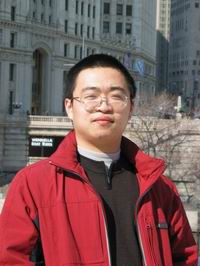
Introduction
Dr. Wang received his B.S. degree from
Department of Electronic Engineering
at Tsinghua University, China, in 2002,
and his M.S. and Ph.D. degrees from
Department of Electrical Engineering and Computer Science
at Northwestern University in 2005 and 2008, respectively.
He joined Department of Electrical and Computer Engineering
at Illinois Institute of Technology as an assistant professor in 2008.
Research
Dr. Wang's research interest is on design automation of VLSI circuits and large scale
computing systems, where algorithms and methodologies are developed to overcome
the system complexity and the silicon complexity such that the correctness and
the efficiency of the systems are guaranteed. He is also interested in general
algorithm and mechanism design that would apply to fields beyond VLSI CAD.
Courses
Publications
The papers here are copyrighted by the corresponding organizations.
They have been made available as a courtesy.
Journal articles
-
C. Lin, Jia Wang, and H. Zhou,
Clustering for Processing Rate Optimization.
IEEE Transactions on VLSI Systems, 14(11), pp. 1264-1275, Nov. 2006.
-
Jia Wang and H. Zhou,
Optimal Jumper Insertion for Antenna Avoidance Considering Antenna Charge Sharing.
IEEE Transactions on Computer-Aided Design, 26(8), pp. 1445-1453, Aug. 2007.
-
Z. Gu, Jia Wang, R. P. Dick, and H. Zhou,
Unified Incremental Physical-Level and High-Level Synthesis.
IEEE Transactions on Computer-Aided Design, 26(9), pp. 1576-1588, Sep. 2007.
-
Jia Wang, D. Das, and H. Zhou,
Gate Sizing by Lagrangian Relaxation Revisited.
IEEE Transactions on Computer-Aided Design, 28(7), pp. 1071-1084, Jul. 2009.
-
W. Xu, Jia Wang, Y. Hu, J.-Y. Lee, L. He, and M. Sarrafzadeh,
In-Place FPGA Retiming for Mitigation of Variational Single-Event Transient Faults.
IEEE Transactions on Circuits and Systems I, 58(6), pp. 1372-1381, Jun. 2011.
-
X. Xiong and Jia Wang,
Dual Algorithms for Vectorless Power Grid Verification under Linear Current Constraints.
IEEE Transactions on Computer-Aided Design, 30(10), pp. 1469-1482, Oct. 2011.
-
J. Wu, Jia Wang, K. Li, H. Zhou, Q. Lv, L. Shang, and Y. Sun,
Large-Scale Energy Storage System Design and Optimization for Emerging Electric-Drive Vehicles.
IEEE Transactions on Computer-Aided Design, 32(3), pp. 325-338, Mar. 2013.
-
C. Wang, K. Ren, Jia Wang, and Q. Wang,
Harnessing the Cloud for Securely Outsourcing Large-Scale Systems of Linear Equations.
IEEE Transactions on Parallel and Distributed Systems, 24(6), pp. 1172-1181, Jun. 2013.
-
X. Xiong and Jia Wang,
Verifying RLC Power Grids with Transient Current Constraints.
IEEE Transactions on Computer-Aided Design, 32(7), pp. 1059-1071, Jul. 2013.
-
L. Hua, Jia Wang, and C. Zhou,
Adaptive Electric Vehicle Charging Coordination on Distribution Network.
IEEE Transactions on Smart Grid, 5(6), pp. 2666-2675, Nov. 2014.
-
N. Gupte and Jia Wang,
Secure Power Grid Simulation on Cloud.
IEEE Transactions on Computer-Aided Design, 34(3), pp. 422-432, Mar. 2015.
-
Jia Wang, X. Xiong, and X. Zheng,
Deterministic Random Walk: A New Preconditioner for Power Grid Analysis.
IEEE Transactions on Very Large Scale Integration Systems, 23(11), pp. 2606-2616, Nov. 2015.
-
C. Wang, K. Ren, and Jia Wang,
Secure Optimization Computation Outsourcing in Cloud Computing: A Case Study of Linear Programming.
IEEE Transactions on Computers, 65(1), pp. 216-229, Jan. 2016.
-
Z. Zhou, X. Yang, D. Zhao, P. Rich, W. Tang, Jia Wang, and Z. Lan,
I/O-Aware Bandwidth Allocation for Petascale Computing Systems.
Parallel Computing, 58, pp. 107-116, Oct. 2016.
-
C. Cao,
J. He,
L. Mak,
D. Perera,
D. Kwok,
Jia Wang,
M. Li,
T. Mourier,
S. Gavriliuc,
M. Greenberg,
A.S. Morrissy,
L.K. Sycuro,
G. Yang,
D.C. Jeffares,
and Q. Long,
Reconstruction of Microbial Haplotypes by Integration of Statistical and Physical Linkage in Scaffolding.
Molecular Biology and Evolution, msab037, Feb. 2021.
Refereed conference papers
-
Jia Wang and H. Zhou,
Minimal Period Retiming under Process Variations.
Great Lake Symposium on VLSI, Boston, MA, 2004.
(poster)
-
H. Zhou and Jia Wang,
ACG--Adjacent Constraint Graph for General Floorplans.
IEEE International Conference on Computer Design, San Jose, CA, 2004.
(talk)
-
Jia Wang and H. Zhou,
Interconnect Estimation Without Packing via ACG Floorplans.
Asia and South Pacific Design Automation Conference, Shanghai, China, 2005.
(poster)
-
Z. Gu, Jia Wang, R. P. Dick, and H. Zhou,
Incremental Exploration of the Combined Physical and Behavioral Design Space.
ACM/IEEE Design Automation Conference, Anaheim, CA, 2005.
-
C. Lin, Jia Wang, and H. Zhou,
Clustering for Processing Rate Optimization.
IEEE/ACM International Conference on Computer-Aided Design, San Jose, CA, 2005.
(Technical Report TR-NUCAD-2005-02)
-
Z. P. Gu, Y. Yang, Jia Wang, R. P. Dick, and L. Shang,
TAPHS: Thermal-Aware Unified Physical-Level and High-Level Synthesis.
Asia and South Pacific Design Automation Conference, 2006.
(One of eight best paper award nominees out of 432 submitted papers.)
-
Jia Wang, P. Wu, and H. Zhou,
Processing Rate Optimization by Sequential System Floorplanning.
International Symposium on Quality Electronic Design, San Jose, CA, 2006.
(poster)
-
Jia Wang and H. Zhou,
Optimal Jumper Insertion for Antenna Avoidance under Ratio Upper-Bound.
ACM/IEEE Design Automation Conference, San Francisco, CA, 2006.
(talk)
(benchmarks)
-
N. Liveris, C. Lin, Jia Wang, H. Zhou, and P. Banerjee,
Retiming for Synchronous Data Flow Graphs.
Asia and South Pacific Design Automation Conference, 2007.
-
Jia Wang, M.-Y. Kao, and H. Zhou,
Address Generation for Nanowire Decoders.
ACM Great Lakes Symposium on VLSI, Stresa, Italy, 2007.
(poster)
-
Jia Wang, D. Das, and H. Zhou,
Gate Sizing by Lagrangian Relaxation Revisited.
IEEE/ACM International Conference on Computer-Aided Design, San Jose, CA, 2007.
(talk)
-
Jia Wang and H. Zhou,
An Efficient Incremental Algorithm for Min-Area Retiming.
ACM/IEEE Design Automation Conference, Anaheim, CA, 2008.
(talk)
(benchmarks)
-
Jia Wang and H. Zhou,
Linear Constraint Graph for Floorplan Optimization with Soft Blocks.
IEEE/ACM International Conference on Computer-Aided Design, San Jose, CA, 2008.
(talk)
-
Jia Wang and H. Zhou,
Exploring Adjacency in Floorplanning.
Asia and South Pacific Design Automation Conference, Yokohama, Japan, 2009.
(talk)
-
Jia Wang and H. Zhou,
Risk Aversion Min-Period Retiming under Process Variations.
Asia and South Pacific Design Automation Conference, Yokohama, Japan, 2009.
(talk)
-
X. Yuan and Jia Wang,
Statistical Timing Verification for Transparently Latched Circuits
through Structural Graph Traversal.
Asia and South Pacific Design Automation Conference, Taiwan, 2010.
-
D. Das, Jia Wang, and H. Zhou,
iRetILP: An Efficient Incremental Algorithm for Min-Period Retiming
under General Delay Model.
Asia and South Pacific Design Automation Conference, Taiwan, 2010.
-
X. Xiong and Jia Wang,
An Efficient Dual Algorithm for Vectorless Power Grid Verification
under Linear Current Constraints.
ACM/IEEE Design Automation Conference, Anaheim, CA, 2010.
(benchmarks)
-
X. Xiong and Jia Wang,
A Hierarchical Matrix Inversion Algorithm for Vectorless Power Grid Verification.
IEEE/ACM International Conference on Computer-Aided Design, San Jose, CA, 2010.
-
C. Wang, K. Ren, and Jia Wang,
Secure and Practical Outsourcing of Linear Programming in Cloud Computing.
IEEE International Conference on Computer Communications, Shanghai, China, 2011.
-
C. Wang, K. Ren, Jia Wang, and K. Mahendra Raje Urs,
Harnessing the Cloud for Securely Solving Large-scale Systems of Linear Equations.
IEEE International Conference on Distributed Computing Systems, Minneapolis, MN, 2011.
-
X. Xiong and Jia Wang,
Vectorless Verification of RLC Power Grids with Transient Current Constraints.
IEEE/ACM International Conference on Computer-Aided Design, San Jose, CA, 2011.
(talk)
-
Jia Wang,
Deterministic Random Walk Preconditioning for Power Grid Analysis.
IEEE/ACM International Conference on Computer-Aided Design, San Jose, CA, 2012.
(talk)
-
X. Xiong and Jia Wang,
Constraint Abstraction for Vectorless Power Grid Verification.
ACM/IEEE Design Automation Conference, Austin, TX, 2013.
-
Jia Wang and X. Xiong,
Scalable Power Grid Transient Analysis via MOR-Assisted Time Domain Simulations.
IEEE/ACM International Conference on Computer-Aided Design, San Jose, CA, 2013.
-
N. Gupte and Jia Wang,
Securely Outsourcing Power Grid Simulation on Cloud.
ACM Great Lakes Symposium on VLSI, Houston, TX, 2014.
-
X. Yang, X. Zheng, Z. Zhou, W. Tang, Jia Wang, and Z. Lan,
Balancing Job Performance with System Performance via Locality-Aware Scheduling on Torus-Connected Systems.
IEEE Cluster, Madrid, Spain, 2014.
-
X. Xiong and Jia Wang,
Vectorless Transient Power Grid Verification: A Case Study with IBM Benchmarks.
IEEE Symposium on Electromagnetic Compatibility and Signal Integrity, Santa Clara, CA, 2015.
-
Z. Zhou, X. Yang, D. Zhao, P. Rich, W. Tang, Jia Wang, and Z. Lan,
I/O-Aware Batch Scheduling for Petascale Computing Systems.
IEEE International Conference on Cluster Computing, Chicago, IL, 2015.
-
S. Yao, X. Chen, J. Zhang, Q. Liu, Jia Wang, Q. Xu, Y. Wang, and H. Yang,
FASTrust: Feature Analysis for Third-party IP Trust Verification.
IEEE International Test Conference, Anaheim, CA, 2015.
-
N. Gupte and Jia Wang,
Transient Noise Bounds Using Vectorless Power Grid Verification.
IEEE/ACM International Conference on Computer-Aided Design, Austin, TX, 2015.
-
X. Zheng, Z. Zhou, X. Yang, Z. Lan, and Jia Wang,
Exploring Plan-Based Scheduling for Large-Scale Computing Systems.
IEEE Cluster, Taipei, Taiwan, 2016.
Invited papers
-
Jia Wang, K. Li, Q. Lv, H. Zhou, and L. Shang,
Hybrid Energy Storage System Integration for Vehicles.
International Symposium on Low Power Electronics and Design, Austin, TX, 2010.
-
X. Xiong and Jia Wang,
Parallel Forward and Back Substitution for Efficient Power Grid Simulation.
IEEE/ACM International Conference on Computer-Aided Design, San Jose, CA, 2012.
-
D. Sinha, L. G. e Silva, Jia Wang, S. Raghunathan, D Netrabile, and A Shebaita,
TAU 2013 Variation Aware Timing Analysis Contest.
International Symposium on Physical Design, Stateline, NV, 2013.
Activities
ACG Floorplanner
-
The ACG Floorplanner is maintained here.
This floorplanner has been used in many collaborated research works.
Students
Dr. Wang is current recruiting students to join his research group.
Financial support will be provided to qualified Ph.D students.
Researches in design automation/VLSI CAD
provide necessary tools for the design of VLSI chips.
Though device technology may evolve, CAD techniques will remain essential
to organize individual devices into efficient and effective systems
and to automate the tasks of system analysis, verification, and optimization.
Since the research work requires not only theoretical algorithmic
advances but also efficient practical software implementations,
students will be trained to achieve a good balance between mathematical
reasoning and software development skills.
Such training will prepare students for EDA tool vendors or any
career requiring strong quantitative and programming skills.
Though not required, knowledge of combinatorics,
optimization algorithms (linear programming,
convex programming, etc.), and C++/STL will be a plus for the applicants.